
What Cecil County Deed Records Contain
The Clerk of the Circuit Court land-record collection keeps Cecil County's deeds, mortgages, deeds of trust, leases, releases, and land contracts. Those records are permanent. Each deed names its parties. It also describes the land and records the date the Clerk accepted the transaction, and the deed type matters because not every conveyance carries the same promises.
| Deed Type | What It Does | Common Use |
|---|---|---|
| General warranty deed | Conveys the described interest with broad covenants from the grantor | Arm's-length transfers where broad assurances are stated |
| Special warranty deed | Limits the grantor's warranties to claims arising during that grantor's ownership | Commercial and fiduciary transfers |
| Quitclaim deed | Conveys whatever interest the grantor has without promising that the interest is complete | Family, estate, or title-cleanup transactions |
| Trustee or personal-representative deed | Transfers property through a stated fiduciary capacity | Trust administration, estates, or court-directed sales |
| Tax-sale deed | May complete a transfer after the statutory tax-sale and foreclosure process | Delinquent-tax proceedings, not an ordinary sale |
A mortgage or deed of trust secures a debt. An assignment swaps the secured party. A release or certificate of satisfaction can clear the referenced instrument. None of these filings is a new ownership deed, so match the book/page, parties, and legal description before tying any encumbrance to a Cecil County parcel.
Bridge from SDAT to the Cecil Deed Index
Maryland SDAT Real Property Search will not find Cecil County accounts by owner name, town, subdivision, neighborhood, or ZIP. Address, street name, account identifier, and map reference all work. The parcel card is the payoff. It can show the Owner Name carried from the last recorded deed, premises and mailing addresses, map/grid/parcel, plat, sale information, and a deed reference.
- Select Cecil County and locate the correct assessment account by address, account, or map reference.
- Copy the complete deed reference, owner spelling, parcel identifiers, and legal-description clues.
- Open MDLandRec and use the reference for a direct book/page retrieval or use the parties in an index search.
- Compare the deed's land description with the assessment account; do not join two records on a similar street address alone.
For full address rules and account construction, turn to the Cecil County property search guide. Deed research starts once the parcel is fixed.
Note: Cecil County code 08 belongs to the SDAT account workflow; it is not a deed-book or instrument number.
Fields Inside Maryland Land Records
MDLandRec is the Maryland State Archives entry point for land-record index and image research. Some access requires an account. The official search aid says to begin broadly.
| Search path | Fields or controls | Best use |
|---|---|---|
| Direct image | Clerk, Book, Page; book and page required | Pull one page when SDAT or another deed supplies the reference |
| Party index | Individual/corporate; grantor/grantee; name; date; instrument type | Discover transfers into or out of an owner |
| Name refinement | Contains, begins, ends, fuzzy, Soundex, cross-reference | Handle spelling, suffix, and historic-index variation |
Cecil's electronic groups named in the guide include COTT 1970, CAIS 1994, and ELROI 2005. Treat those as starting points. Coverage years vary by series. Not every deed image or index entry begins in one uniform year. For direct retrieval, the official book/page search guide illustrates the route.
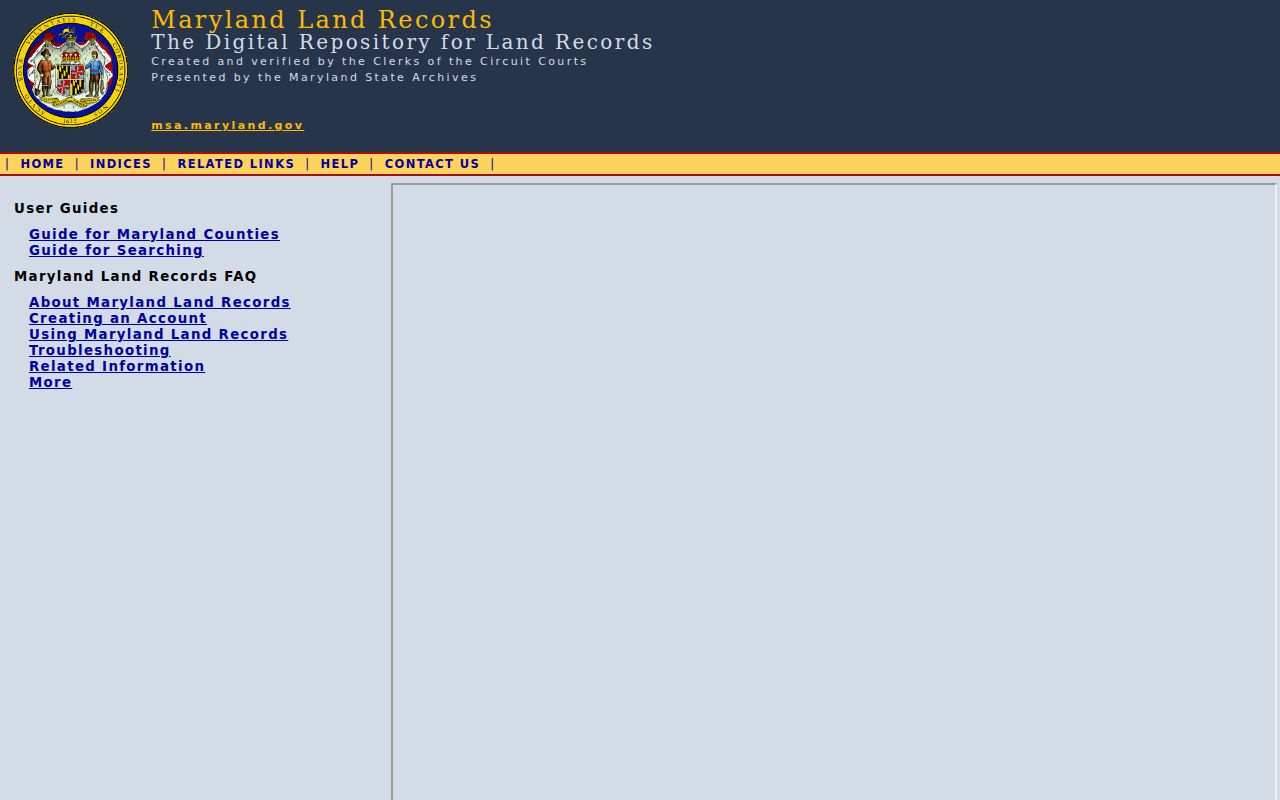
An exact deed reference saves real time on MDLandRec. Direct retrieval needs both a book and a page, not a street address.
Follow Cecil County's Grantor-Grantee Trail
The grantee received the interest. The grantor conveyed it. A current purchase deed in Cecil County therefore names both the latest incoming owner and the immediately preceding party, and running each name in both directions can surface a later sale, correction, or related instrument.
- Find the latest purchase deed with the present owner indexed as grantee, using the SDAT reference as a check.
- Read the grantor, recording and instrument dates, legal description, and any stated prior reference.
- Search that grantor as an earlier grantee, broaden name variants when necessary, and open the matching acquisition deed.
- Repeat while the parcel description remains continuous; move to the Archives series when the electronic group or image trail ends.
- Grantor
- The party conveying the interest; often, but not always, the seller.
- Grantee
- The party receiving the interest named by the instrument.
- Chain of title
- The ordered sequence of conveyances tied to the same described land.
- Book/page and instrument reference
- Record locators that identify the indexed or imaged filing; preserve whichever format the source displays.
A tidy name sequence can still be incomplete. Estates, trustees, personal representatives, mergers, boundary agreements, and court orders can shift the indexed capacity or bridge a surname gap. Read the instrument itself.
Separate Deeds from Cecil Encumbrance Filings
Deeds of trust, mortgages, assignments, releases, certificates of satisfaction, powers of attorney, liens, financing statements, subordination agreements, easements, affidavits, and trustee appointments all appear in the MDLandRec search aid alongside deeds. That vocabulary helps narrow a result. It is not a complete promise, though. Coverage varies across index eras.
| Ownership instrument | Read grantee, grantor, capacity, legal description, consideration if stated, and prior deed reference. |
|---|---|
| Secured-debt filing | Match borrower, lender or trustee, amount if public, parcel description, and the original book/page. |
| Release or satisfaction | Confirm exactly which mortgage, deed of trust, or lien the filing references. |
| Easement or agreement | Follow “subject to,” “together with,” reservation, and cross-reference clauses into related images or plats. |
For a legal starting point, see Maryland Courts' property-transfer guidance. Parcel-specific legal questions belong with a qualified professional.
When a Cecil Deed Points to a Plat
A deed may point to a lot, section, subdivision, road taking, wetland map, or earlier survey instead of restating every boundary. PLATS.NET for Cecil County is the place to start. Use it when a deed or SDAT card supplies a plat reference. Basic mode covers book, page, plat or box, right-of-way, cabinet, and slot fields, while Advanced mode adds date, description, clerk initials, and sort order. Series mode reaches archival groups.
Cecil holdings run deep. Patents and certificates reach into the seventeenth century. Division Plats begin in 1724. Later series include land-commission and land-record plats, a Plat Book run from 1925–1999, subdivision plats, wetland maps, and state-road plans. A plat can explain changed lot geometry or an easement reference, but the map image alone proves no later transfer or approval.
Read the record type. A planning proposal, approved county minor plat, recorded Clerk plat, deed restriction, and GIS line answer different questions even when they share a project name.
Cecil Deed Books Extend Beyond the Portal
The Maryland State Archives container guide documents paper, electronic, and microfilm routes into Cecil County's deed books. Cecil series include the original index for 1674–1918, a land-record index covering 1850–1951, original grantor and grantee series for 1918–1992, and court land records from 1674–1851. Charlestown has its own groups. Those cover 1744–1851 and 1852–1920.
The finding aid helps when electronic images end. It also matters when a historical place name replaces a modern address, or a legal description changes after a division. Record the series identifier, format, coverage, and jurisdiction you see. Never assume every listed volume is online.
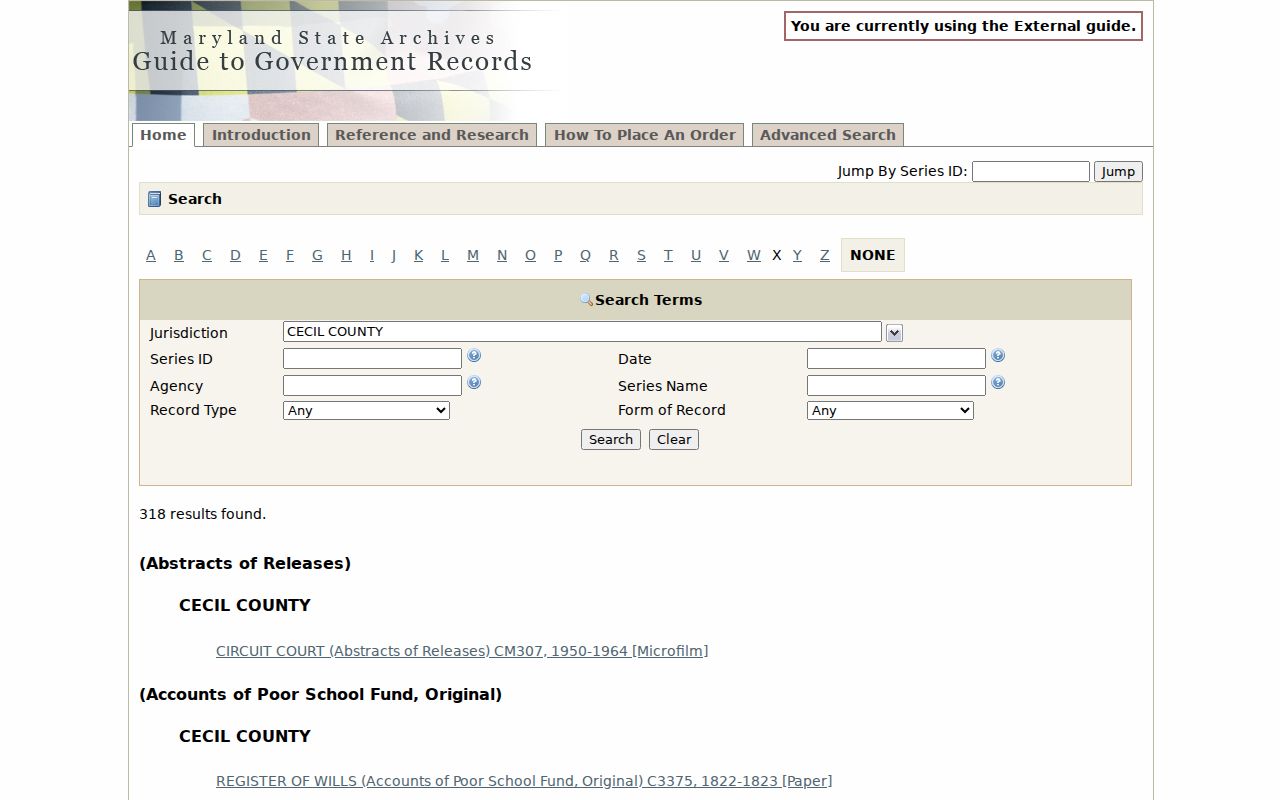
This inventory locates containers and series. It cannot replace the deed book itself or a certified Clerk record.
Note: No official courthouse-fire records-loss event was confirmed in the research; do not attribute an index gap to a fire.
Obtain a Cecil County Deed Copy
MDLandRec works well for everyday copies. Its images cost nothing beyond registration. When you need something official, go through the Clerk of the Circuit Court for Cecil County instead.
The Land Records Department sits at 129 East Main Street, Room 114, Elkton, Maryland 21921, and answers the phone at 410-996-5375. A request should spell out the party names, the document you want, your delivery and contact details, your payment, and whether you need a plain or certified copy. The Clerk's posted rates put regular copies at fifty cents per page and certified copies at $5.50 each. The request PDF breaks certification down differently, at $5 plus fifty cents per page, so verify the math before mailing a check.
These channels overlap rather than compete. Use the webpage, the form, a phone call, or the counter, whichever suits you. For older instruments, the Archives guide and the local library can point toward leads. They will not produce a current certified deed, though.
Recorded, not guaranteed. Cecil County deed records show instruments accepted into the land records; an index hit or image is not a title opinion, and unrecorded interests or later filings may exist.
Keep a date-stamped log of your deed research. Note the source, party query, index direction, instrument type, and book and page for each step, along with image availability and any legal-description mismatch you spot. That discipline makes a Cecil County deed chain reproducible later, even if a portal result or a current assessment card changes down the line.