
Compare Cecil County Property Value Types
Cecil County keeps value data in more than one place. The Maryland SDAT Real Property Search is the official starting point for assessment value. Recorded deeds and the county Finance office supply separate sale and tax evidence.
| Value type | Meaning in the record | Primary source |
|---|---|---|
| Total assessment | SDAT's combined land and improvement value for the stated assessment period | SDAT card |
| Land value | Assessment component assigned to land | SDAT card |
| Improvement value | Assessment component assigned to structures and improvements | SDAT card |
| Recorded consideration | Amount reported for a transfer; it may not be an arm's-length price | Deed and SDAT transfer field |
| Taxable assessment | Amount affected by phase-in and qualifying credits before rates and charges | SDAT / Finance |
Maryland skips the separate 50 percent ratio and assesses real property at fair-market-value level. Taxable assessment can still drift away from the displayed market figure. Phased increases and tax credits do that quietly. A sale amount moves for its own reasons too. Timing, condition, financing, or the nature of the transfer can shift it. Knowing which number you hold matters before you compare.
Read the Cecil SDAT Value Fields Together
A typical card holds assessment year, base, land, improvement, and total values. Use, county use, class, tax-exempt status, and principal-residence flags sit alongside them. Consideration, sale data, deed reference, structure age, living area, basement area, and land area may appear too. Capture the whole row and year. One extracted total tells you little on its own. Physical fields can explain why two nearby accounts differ. Treat them as assessment attributes, not a building inspection. If square footage, a structure entry, or a pending permit looks wrong, check county Permits & Inspections and the assessment worksheet first. Only then treat the figure as fact.
Locate a Cecil County Property Value
Keep the identifier, value year, and source together through the lookup.
- Select Cecil County, code 08, in SDAT and search by street address, street name, account/PAN, or map reference.
- Confirm premises address and account, then capture assessment year, reassessment area, land, improvement, total, and classification fields.
- Read the transfer date, consideration, and deed reference only as links to the recorded transaction.
- Use the assessment worksheet and SDAT sales analysis when testing an assessment; use a current appraisal for a transaction-specific opinion.
- Assessment
- SDAT's mass-appraisal value for property-tax administration.
- Recorded consideration
- The transfer amount reported in the instrument, which may reflect a non-market conveyance.
- Level of assessment
- Assessed value divided by sale price as used in ratio analysis, not a parcel appraisal.
- Taxable assessment
- The amount to which rates apply after applicable phase-in and credits.
The official SDAT search guide shows Cecil's address and account routes:
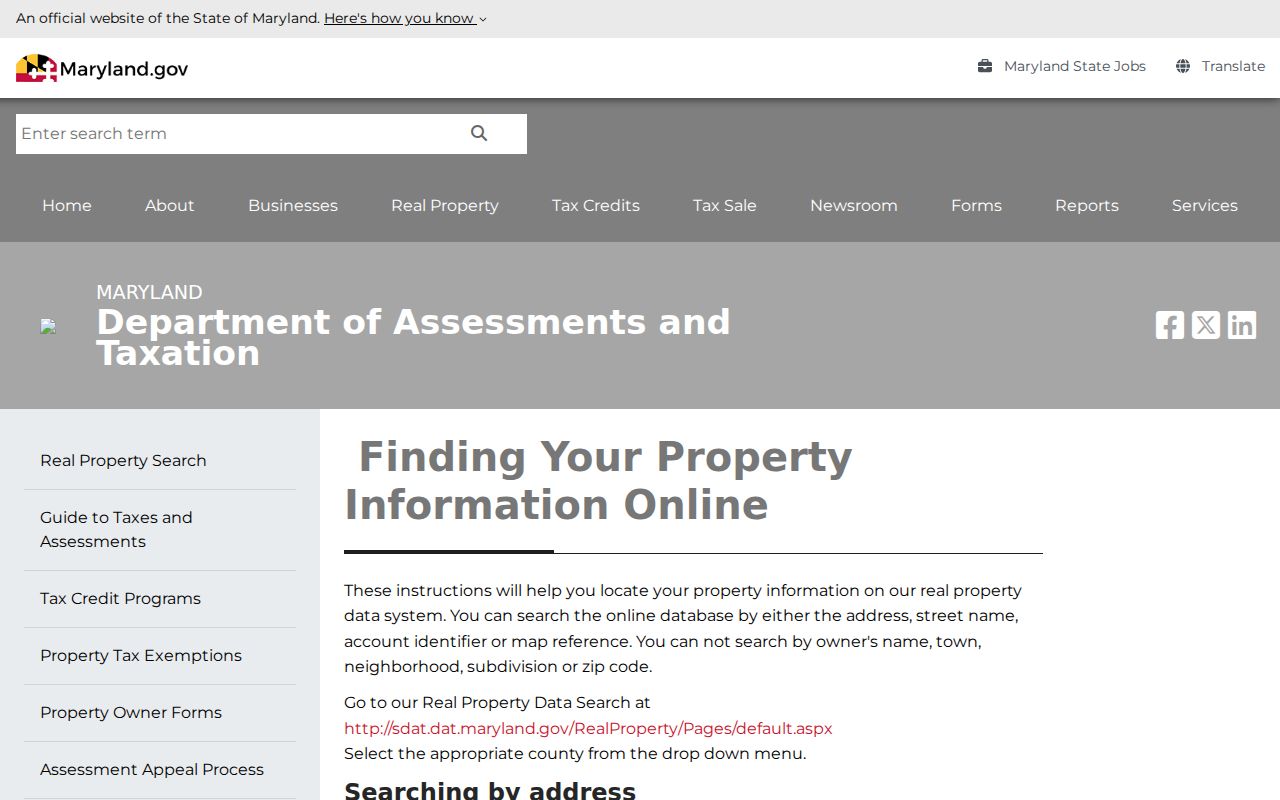
These formats help most when a directional or address suffix returns a blank result.
Cecil's Three Reassessment Areas Set the Clock
Maryland values each property on a three-year cycle, with roughly one-third reassessed every year. Cecil Area 1 took effect in 2025 and comes up again in 2028. Area 2 took effect in 2023 and is next listed for 2026. Area 3 took effect in 2024 and returns in 2027. When an assessment rises, the increase phases in equally over three years. That clock explains a common puzzle. These four numbers may not move together at all. They are the new market assessment, the phased amount, the taxable assessment, and the tax bill. Compare like years and identify the reassessment area before calling anything an error.
Note: The December 2025 SDAT release describes statewide 2026 Group 2 growth; it is context, not a Cecil parcel value.
Cost, Sales, and Income Approaches Serve Different Properties
The Maryland Homeowners' Guide describes three valuation approaches: cost, sales comparison, and income. Cost analysis weighs replacement and depreciation. Sales comparison leans on relevant transfers. Income analysis can matter for income-producing property. Whatever the mix, the result is a mass-appraisal conclusion. A nearby sale is not automatically comparable. Date, property type, size, condition, land, improvements, location, and whether the transfer was arm's length all count. The county GIS map can spot nearby accounts, but it will not pick valid appraisal comparables for you.
Recorded Consideration May Be a Misleading Benchmark
SDAT defines consideration as the recorded price at which title transferred. Plenty of deeds carry numbers that mislead. Related-party transfers, gifts, nominal consideration, partial interests, corrections, and estate transfers all sit outside the market. Follow the deed reference and read the instrument before comparing anything. A mortgage amount is not a value conclusion either. It reflects financing, not an independent opinion of the whole property. Keep deed consideration, mortgage, assessment, tax bill, and appraisal in separate columns. Do this when you build a Cecil property file.
Homestead Caps Tax Growth, Not Market Meaning
Maryland caps taxable-assessment growth for an eligible principal residence. The cap applies to county and municipal purposes. It is set at 10 percent or less. The Homestead Tax Credit can therefore hold the taxable amount well below the market assessment. Applications run through SDAT online or by paper or fax. A denial can be appealed within 30 days.
The Principal Residence field on the card is just an assessment classification. It does not prove continuous occupancy. For value work, its only relevance is the applicable assessment and credit calculation.
Test a Cecil Assessment Within the Appeal Window
A regular appeal is generally due within 45 days of the notice. The online appeal form asks for Cecil County, a numeric Notice Number, and a Control Number. It states that you cannot appeal property you do not own. Those identifiers are not on the current card. SDAT materials outline a no-charge sales analysis. They also list a property worksheet, and a written, phone, or personal review. Later routes run through the Property Tax Assessment Appeals Board and then Maryland Tax Court. Preserve the notice date and your evidence. An appeal challenges the assessment only, never the deed or the Finance payment record.
Audit a Cecil Value Mismatch Without Inventing an Appraisal
Numbers that disagree are rarely a real conflict. SDAT, Cecil Maps, a deed, and the tax account may show different figures. Tag each one by its source and date. Confirm every source points to the same account and premises. Check the PAN. Then pull the figures apart. Separate land value, improvement value, total market assessment, phased or taxable assessment, recorded consideration, and the billed amount. Most mismatches vanish once unlike fields stop sharing one "value" column.
Next, check the assessment year and the Cecil reassessment area. A Homestead credit or three-year phase-in can hold taxable growth below market growth. That looks odd, but it is by design. When the deed consideration seems strange, read the deed itself. Family transfers, estate moves, corrections, gifts, partial interests, and nominal sales do not reflect an open-market price. If the physical facts shifted, check permit and structure records too.
Document any difference that survives this work rather than guessing a figure. SDAT's Cecil office can walk through assessment fields and supply a worksheet. Finance explains the bill. The Clerk supplies the instrument. Public records cannot always settle the question. When they cannot, a qualified appraiser can develop a current opinion of value.
What a Cecil County Assessor Value Cannot Promise
An assessment has firm limits. It does not predict what a particular buyer will pay, establish replacement cost for insurance, certify physical condition, or resolve title questions. Because it sits inside a statutory cycle and a mass-appraisal process, it can lag changing conditions on the ground. When an independent opinion of value is genuinely required, a current property-specific appraisal is the right source, not the assessor's number.
Value versus price. A Cecil County property value on the assessment roll is not a guaranteed sale price. Use a qualified Maryland appraiser for a current, property-specific market opinion.
For bills, payment timing, and tax-sale warnings, the property tax records guide covers the ground. Finance owns those questions. They should never be inferred from assessment value alone, and any quoted or compared Cecil County property value should carry its assessment date.